04 — The research
1.5 h late
Bright evenings move the clock.
The body clock, after an evening of bright screens. Less blue light in those hours, less delay. Sensitivity peaks around 480 nm — the same place the amber lens works.
- ≈ 1.5 h
- ≈ 480 nm
- later by ~1.5 h
- Laboratory
What it means for you
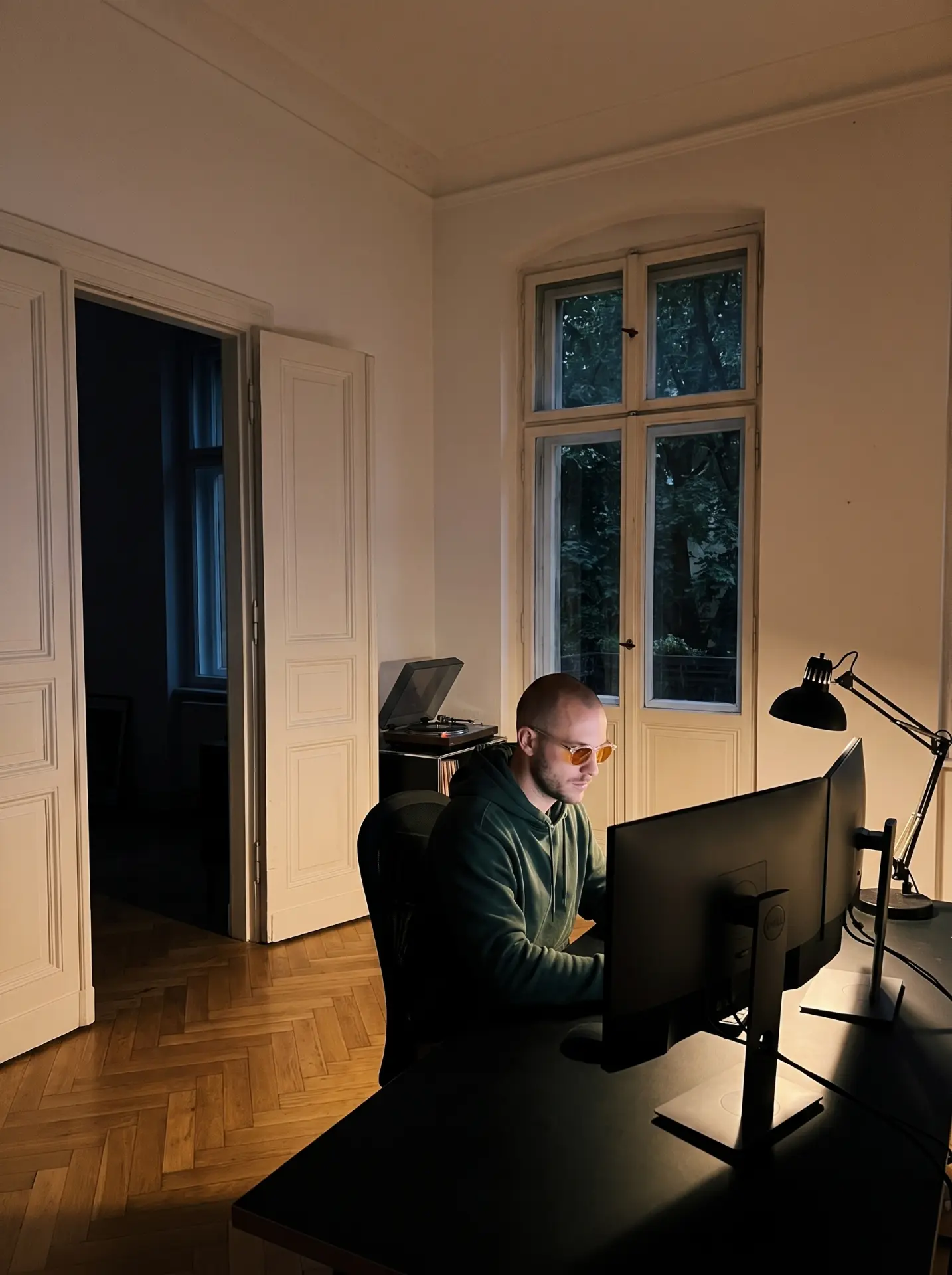
The evening reads warmer
Displays and LED lamps lose their cool cast. The room looks the way lamplight used to look before screens.
Less glare, less squinting
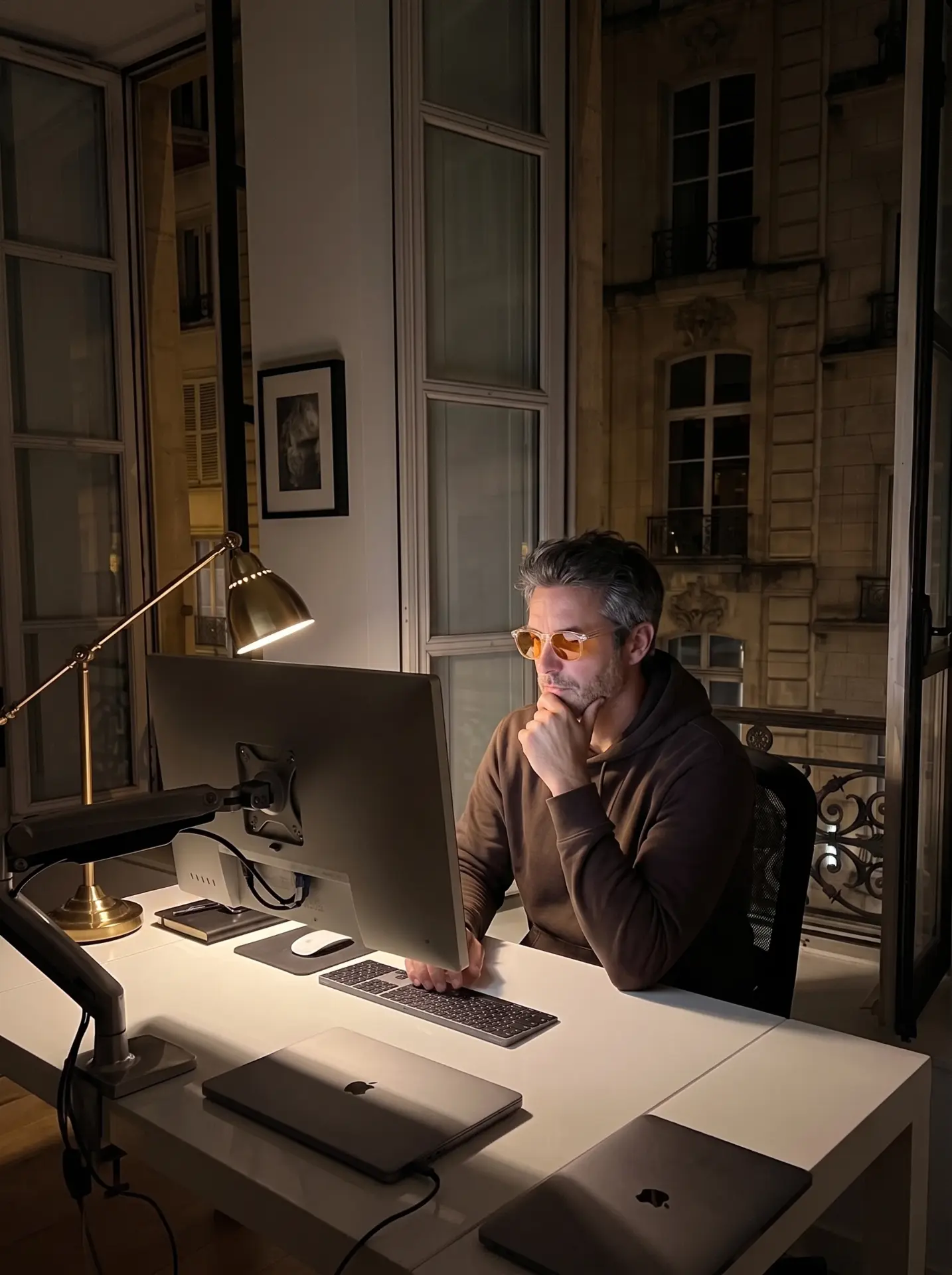
White interfaces stop cutting. Long evening sessions at a monitor feel less sharp on the eyes.
The wind-down starts earlier
Removing the short end of the spectrum after dark is the part of the evening you can actually control.
Nothing else changes
Light above roughly 500 nm passes nearly untouched, so the room stays readable and the work continues.
The papers
We describe the light. The rest of the evening is yours.
Chang et al., PNAS 2015
Evenings of light-emitting screen reading delayed the body clock and pushed melatonin onset later by about 1.5 hours compared with print.
Thapan et al., 2001
The action spectrum for melatonin suppression in humans peaks in the short-wavelength range near 460 — 480 nm, not in the visible range the eye reads as brightness.
Brainard et al., 2001
An independent action spectrum places peak circadian sensitivity at a similar short wavelength, pointing to a non-visual photoreceptor.
Findings come from controlled laboratory studies of light and the body clock. AFTEN is eyewear, not a medical device.
One frame, one lens, for the hours after daylight.
See the glasses — $79