Journal / 03
Clear lenses, amber lenses, and what the difference costs you
Two lenses can both be sold as blue-light glasses and do almost nothing alike. The difference is visible from across a room.
The clear-lens promise
A clear lens with a faint blue-light coating is easy to sell: it looks like ordinary glasses, so nobody has to explain themselves at dinner. It usually filters a small single-digit percentage of blue light, spread thinly across the range.
That is fine for a screen at noon. After dark, it is close to nothing.
Why colour is the giveaway
Removing the short wavelengths from white light leaves warm light behind. That is not a styling choice, it is arithmetic. A lens that takes out the deep blue has to look amber.
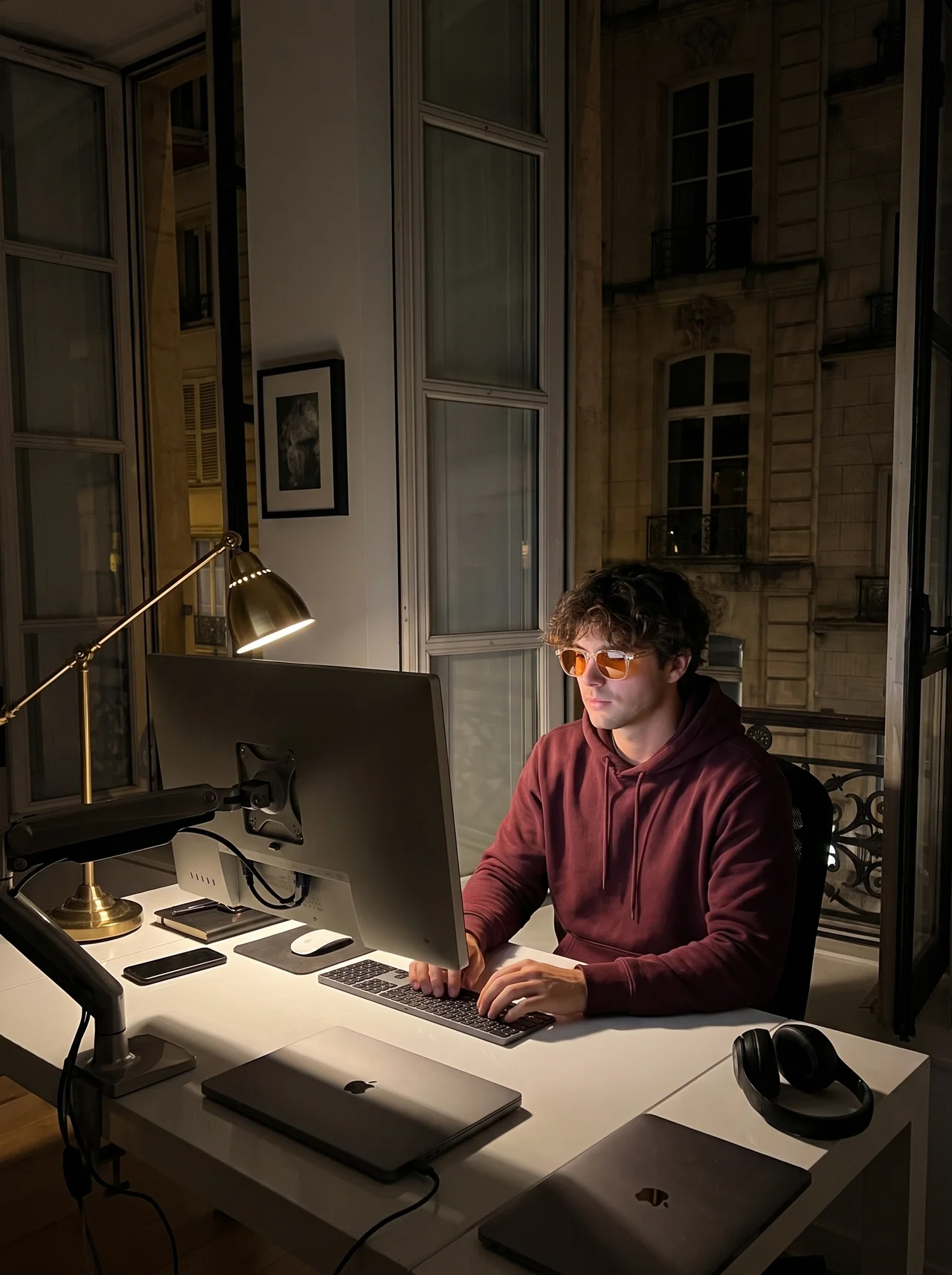
So the tint is the evidence. You can watch it happen: put the glasses on in front of a screen and the blue-white goes to paper and honey.
Side by side
No brand names, no invented tests — just the things worth comparing before you spend anything.
Typical blue-light glasses
AFTEN One
Blue light actually blocked
A few percent. Mostly marketing.
Nearly all of it below 450 nm.
Lens colour
Clear — looks the same, does little after dark.
Amber — you can see it working.
Made for
All-day, general use.
The hours after sunset.
Transmission data published
Rarely, if ever.
Yes. The full curve is on this page.
Frame
Injection-moulded plastic.
Hand-polished clear acetate.
Case
Soft pouch, or none.
Rigid box that is the case.
Returns
Varies, often none.
30 days.
Price
$10–$30 for glasses that filter little.
$79, or two pairs for $129.
Where the money actually goes
The lens is the expensive part: a tint tuned to a specified cut-off, with the transmission measured rather than estimated. After that, clear acetate polished rather than moulded, a metal hinge, and a rigid box that is also the case.
None of that is exotic. It is just more than a $12 pair can carry.
How to judge any pair, including ours
Ask for the curve. Ask where the cut-off sits and how much passes below 450 nm. Ask whether the figures are measured on the finished lens or copied from a material datasheet.
If a seller cannot answer, the lens is a colour, not a filter.
If a lens changes nothing you can see, it is changing very little you cannot.
What this means for you
- Clear lenses filter a few percent; amber lenses filter the part that matters after dark.
- The tint is not styling — it is the visible proof the filter exists.
- Judge every pair by its published curve, not its marketing.